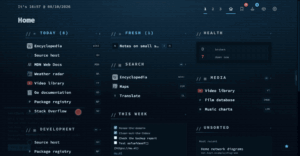
nextDash v1.19.x — a status page, media tiles and tags that know your apps
A status page for the people who use your server, tiles for Jellyfin, Plex, Sonarr and more, a calmer Appearance screen, and tags that recognise your self-hosted apps.
Latest version on GitHub is v1.19.8
Your bookmarks. Your terminal. Your rules.
visitor@nextdash:~/tag/dashboard$ ls ./tag/dashboard
total 12
A status page for the people who use your server, tiles for Jellyfin, Plex, Sonarr and more, a calmer Appearance screen, and tags that recognise your self-hosted apps.
Categories, widgets and collections can be moved anywhere on the dashboard — wide, with the keyboard, or to another page, with Undo. Plus one grouped categories table, Reset all in the look studio, and a roomier What’s new.
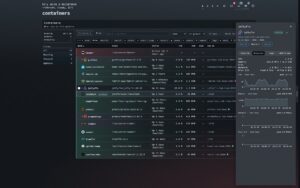
Ten releases between v1.15.1 and v1.17.0, in five days. Most of it is for people who run nextDash next to their containers: the Containers view grew up, Unraid has widgets of its own, and your services get their real icons. The theme browser also became a look studio. Here is what changed, by area. Containers The Containers table has sortable headings, CPU, RAM, Size and Restarts columns you can show or hide, and grouping by project, status, network or image. Shift+Y opens the view from the dashboard. Each container gets a timeline in its side panel: started, crashed with an exit code, turned unhealthy, updated, rolled back. The panel also shows the last five healthcheck results, and l opens a live logs window. nextDash follows Docker’s event stream instead of polling, so a crash the restart policy fixes within seconds still sends a notice. So does a container that stays […]
Your full bookmark list lived in Config, health had a view of its own, and the inbox had a third layout. In v1.15.0 they share one shape: a rail on the left, one-line rows in the middle, a side panel on the right. The Docker host nextDash runs on gets that same shape as a new Containers view. Source and downloads: github.com/jordibrouwer/nextdash — release notes: v1.15.0 on GitHub One collection, one view The Bookmarks view opens from the header icon or #bookmarks. Each row carries tags, shortcut, a health score and 30 days of opens, coloured by how the link is doing. The side panel has three tabs — Details, Health, Usage — on 1 2 3, and Details saves as you type. Group by page, category, site, status or tag. rows jellyfin.lab96 docs.example.org61 retired-service.io12 $ one line per bookmark — health in the glow, use in the bars, the […]
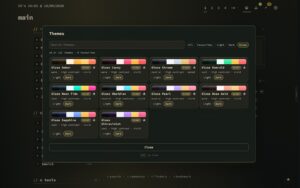
A theme in nextDash was thirteen colours. Nothing in it said whether those colours belonged on lacquer, on paper or on a terminal, so 218 of the 242 built-in themes were drawn flat and matte whatever their palette suggested. In v1.13.3 every theme also names a character, and brings the surfaces it was drawn for along with it. Source and downloads: github.com/jordibrouwer/nextdash — release notes: v1.13.3 on GitHub Twelve characters Lacquer, Glass, Frost, Aurora, Neon, Velvet, Enamel, Brushed, Carbon, Paper, Terminal, Ink. Each is an archetype that fills in the nine surface fields a theme leaves blank: how much light sits on a panel, how far a colour carries around it, how sharp its corners are, whether there is a grain. character Lacquer Glass Paper Brushed One palette, four characters: the same four colours, drawn on four materials. $ the archetype scales what the palette already works out — glass […]
The largest release so far, and most of it answers one question: where does a thing live. The header is one row, the buttons that floated over the grid have somewhere to stand, config opens on tiles, the bookmark list is a workbench, and a fresh install starts on a new look – with a one-minute tour for everyone who already knew where things were.
A short one. Every widget nextDash had read something it already held on your own disk: your links, your checks, your inbox. 1.7.0 adds the first two that look outward instead – at the weather, and at what is coming up in your calendar – along with a layout you can lock and a round of buttons that had stopped matching the themes around them. Source and downloads: github.com/jordibrouwer/nextdash Release notes: v1.7.0 on GitHub Two widgets that look outward Nineteen widget types now, in a new group of their own in the catalogue: What is happening around you? Weather puts current conditions beside a forecast – three days, five days, or the next 24 hours. It does not ask you where you are, because you have already said: it reads the location, source and units you set for the header’s own weather line. Asking a second time would have been […]
This is the biggest thing I have shipped for nextDash: seventy changes across twelve areas, and four of them are new ground rather than a better version of something that was already there. The dashboard can hold blocks that are not bookmarks. A page can be kept somewhere you will still be able to read it after the site goes. The 214 built-in themes are a grid you can search instead of a listbox you scroll. And bookmarks can arrive from services that keep sending them, rather than only from a file you import once. 1.4.0 will open the What’s new window once after you upgrade. There is one behaviour change worth reading before you pull the image — it is under Upgrading, at the bottom. Source and downloads: github.com/jordibrouwer/nextdash — release notes: v1.4.0 on GitHub $ the grid in 1.4.0 — Uptime, Health trend and a Custom widget reading […]
v1.4.0 adds blocks to the grid that hold figures instead of bookmarks — thirteen of them reading data nextDash already keeps, and one Custom widget that reads a number out of any JSON endpoint. Twenty-eight services come pre-filled, so a Sonarr tile is four clicks.
nextDash 1.3.3 rebuilds the page you land on. The overview used to answer “what is new?” in different places at once, none of them well, while the news from the project itself sat below the fold on most screens. It is one list now, newest first. The form for adding a bookmark got the same treatment for the same reason — it had grown taller than a laptop screen, so the Save button was out of sight on the machine most people use. Behind those two visible changes sits something less glamorous and more important: an audit of the whole codebase. It turned up three separate ways you could lose bookmarks, a folder of your private data that was readable by anyone who could reach the app, and outage alerts that never left the building for an entire category of users. All of that is fixed here, and none of […]
A hover card that printed the address twice, hid the one state worth acting on, and slid away when you reached for it. This release rebuilds it into three bands that answer three questions — and gives it everything the rest of the app already knew about the link. Hover a bookmark on the old dashboard and a card appeared. It showed you the title, the full URL in mono, the hostname on the next line, a picture, and the description the page had advertised about itself. Seven stacked divs, two of them saying the same thing. The row underneath it was already showing more. The status dot knew whether the site had answered this morning. The Fresh count knew whether it had published anything. The shortcut letter knew how to reach it without a mouse. The card explaining the row knew less than the row. v1.3.2 rebuilds it. The […]
nextDash 1.2.0 is already out! It is the keyboard release — typing on the dashboard now does only what you meant it to — and it is the release where three views stop claiming to know more than they do: the inbox was counting links it was not showing you, and a failed health check worked out exactly why it had failed and then threw that away. And this morning, 1.2.1 followed with a single fix in Health, which is covered at the end. Source and downloads: github.com/jordibrouwer/nextdash — release notes: CHANGELOG.md nextDash 1.2.0 — 16 August 2026 What you type arrives whole This is the fix that matters most, and it is worth explaining properly, because the old behaviour was subtly worse than it looked. Bookmark shortcuts fired the moment the typed text matched one exactly. Type github with a shortcut on git and the bookmark opened after three […]